
How to Become a Standard Business Sponsor in Australia (2026 Guide)
Becoming a Standard Business Sponsor is the first and most critical step for any Australian employer who intends to hire overseas workers under visas such as the Subclass 482, 494 or 186. Yet many HR teams and business owners are unsure about the exact requirements, the documentation involved and the realistic timelines they are working against. The rules can feel technical, and the Department of Home Affairs requires clear evidence that your business is legally operating, financially sound and genuinely needs the skills you are seeking to sponsor. Missing even minor pieces of documentation can result in significant delays or formal requests for further information that set back your entire recruitment timeline.
This guide simplifies the entire SBS process. Drawing on guidance from the Department of Home Affairs and employer-focused migration resources, it outlines the eligibility criteria, the documents you must prepare and the steps involved in lodging a successful application. You will also find practical checklists and guidance on the most common errors that lead to refusals. Whether you are sponsoring a single employee or building an ongoing international recruitment strategy, this guide provides a clear roadmap to becoming an approved Standard Business Sponsor with confidence.
For a broader overview of your obligations as an employer beyond the SBS application itself, see our complete Employer Sponsorship Compliance Guide.
Table of Contents
What Is a Standard Business Sponsor?
Why SBS Approval Exists
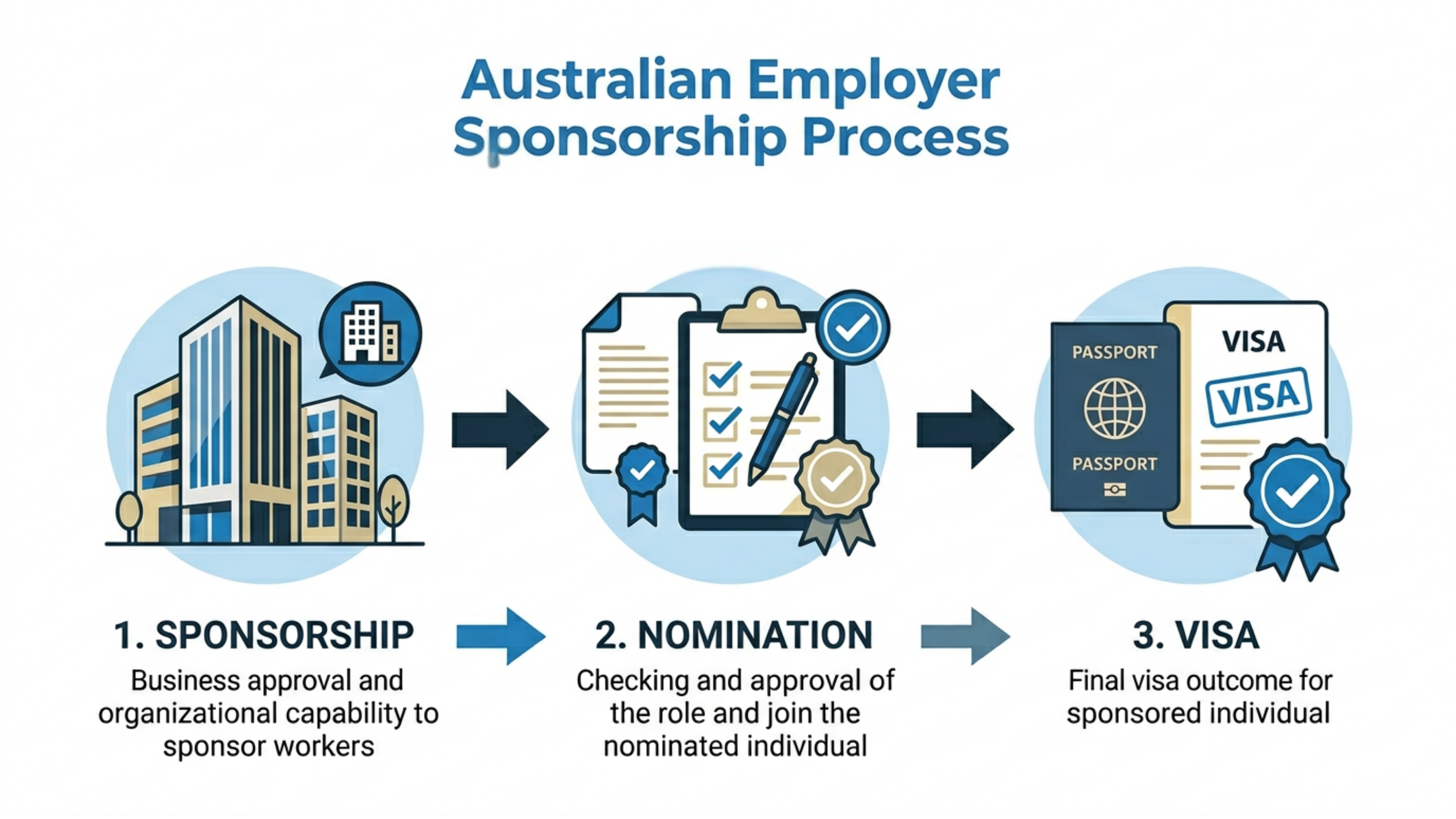
The Standard Business Sponsor framework exists to ensure that only legitimate, compliant and financially stable businesses can access the employer-sponsored visa program. The Department of Home Affairs uses the SBS approval process as the first filter in a three-stage system that also includes nomination and visa application. By requiring businesses to meet a defined eligibility threshold before they can nominate anyone, the Department ensures that overseas workers are placed with employers who are genuinely capable of meeting their obligations.
The SBS framework also underpins the government’s broader objective of prioritising local employment. Businesses must demonstrate that they have a genuine operational need for overseas skills and that they are committed to complying with Australian workplace laws, including those that protect sponsored workers from exploitation.
Key Benefits of Holding SBS Approval
Once approved, a Standard Business Sponsor can nominate overseas workers for roles across a range of skilled visa subclasses, including the Skills in Demand (SID) Subclass 482 visa, the Skilled Employer Sponsored Regional (Subclass 494) visa and the Employer Nomination Scheme (Subclass 186) visa. SBS approval is valid for five years, which means a single successful application enables multiple nominations over a sustained period without needing to re-establish eligibility each time.
Holding SBS approval also gives businesses a competitive advantage in international recruitment. Skilled overseas workers increasingly prioritise employers who have a demonstrated and compliant pathway to visa sponsorship, particularly those who can offer a clear route to permanent residence.
Who Needs SBS Approval
Any Australian employer who intends to sponsor a skilled overseas worker on a Subclass 482, 494 or 186 visa must first hold SBS approval, or apply for it concurrently with the nomination. There are no exemptions based on business size, industry or location. Whether you are a small regional healthcare provider, a mid-sized engineering firm or a national hospitality group, the SBS approval requirement applies equally.
Businesses operating under a Labour Agreement access the sponsorship program through a different pathway and may not require a standard SBS application. If you are unsure which pathway applies to your situation, it is worth seeking advice before investing time in an application that may not be appropriate for your circumstances.
SBS Eligibility Requirements
Lawful Business Operation
The most fundamental requirement for SBS approval is that the business must be lawfully operating in Australia. This means the business must be registered, hold a current ABN and be genuinely engaged in commercial activity at the time of the application. A business that is registered but not actively trading, or one that was recently incorporated without an established operating history, will face significant scrutiny and is unlikely to meet this requirement without additional supporting evidence.
The Department of Home Affairs does not prescribe a minimum period of trading history, but in practice, newly established businesses must work harder to demonstrate genuine operation. Bank statements, client contracts, supplier invoices and evidence of employees on payroll are all useful in building this case.
Financial Viability
Businesses must demonstrate that they are financially capable of meeting the ongoing obligations of an approved sponsor. This includes the ability to pay the sponsored worker’s nominated salary for the full duration of the visa as well as any statutory entitlements. The Department assesses financial viability by reviewing documents such as financial statements, Business Activity Statements, PAYG summaries and, where relevant, tax returns.
Financial viability is not assessed against a fixed dollar threshold. The question the Department is asking is whether the business can genuinely sustain the employment relationship it is proposing. A business with strong revenue but a poor cash flow position may still attract questions if the financial picture is inconsistent.
No Adverse Information
The Department of Home Affairs will assess whether there is any adverse information on record about the business or its key principals that would suggest a risk to the sponsored worker or the integrity of the program. This includes prior sponsorship sanctions, Fair Work Act contraventions, findings of workplace non-compliance or any history of exploiting workers. Businesses with adverse information on record are not automatically disqualified, but the Department has broad discretion to refuse or impose conditions where it considers there is a risk.
SAF Levy Obligations
Standard Business Sponsors are required to pay the Skilling Australians Fund (SAF) levy at the nomination stage, not the SBS stage. However, understanding this obligation before you apply is important because it affects your overall cost modelling. The SAF levy is non-refundable and cannot be recovered from the sponsored worker. Small businesses (annual turnover under AUD 10 million) pay AUD 1,200 per year of visa duration for SID 482 nominations, while large businesses pay AUD 1,800 per year. For full details on the SAF levy and other salary requirements, see our guide on TSMIT and Market Rate Requirements.
If you want to understand how SBS costs and the SAF levy fit into your overall sponsorship budget before lodging anything, a brief conversation with our team can save you time. Call us on +61 8 6288 3775 and we can walk you through the numbers.
Documents Required for an SBS Application
Assembling the right documents before you lodge is the single most effective way to avoid delays. Applications that are missing documents or that include outdated evidence are frequently placed on hold while the Department issues a request for further information, which can add weeks to your processing time.
ABN Registration and Business Registration Evidence
You will need to provide current proof of your Australian Business Number registration. This is typically verified through an ASIC company extract (for incorporated businesses), a sole trader or partnership ABN registration printout, or a trust deed with trustee details where relevant. The documentation must show that the business entity lodging the application matches the entity that will employ the sponsored worker.
Financial Documents
Financial evidence is central to the SBS application. Depending on the size and structure of your business, this may include audited or unaudited financial statements for the most recent financial year, profit and loss statements, balance sheets, and Business Activity Statements covering recent quarters. For smaller or newer businesses, the Department may also accept bank statements demonstrating regular business income and expenditure.
The key is to present a consistent financial picture. If your most recent financial statements show a loss but your BAS suggests strong turnover, you should be prepared to explain the discrepancy clearly rather than hoping the Department will make assumptions in your favour.
PAYG and Payroll Evidence
Evidence of existing employees on payroll demonstrates that the business has experience managing employment relationships and can meet wage obligations. This typically includes PAYG payment summaries or Single Touch Payroll reports showing current employees, recent payroll records, and evidence of superannuation contributions. Businesses with no current employees will need to compensate with stronger evidence of genuine business activity in other areas.
Employment Contracts
Where the sponsored worker has already been identified at the time of the SBS application (which is common when the SBS and nomination are lodged simultaneously), the employment contract or offer letter should be included. This document should reflect the nominated salary, duties and employment terms consistent with the nomination application.
Organisational Chart
An organisational chart showing the current structure of the business, including the reporting lines for the proposed sponsored position, helps the Department understand where the role sits within the organisation and whether it is consistent with the business’s scale and operations. For small businesses with only a few employees, a simple diagram is sufficient. For larger businesses, the chart should show how the sponsored role fits within the relevant team or department.
SBS Application Process: Step by Step
Step 1: Gather and Organise Your Documents
Before lodging, compile all required documents into a clearly labelled evidence pack. Use consistent naming conventions and ensure every document is current. Financial statements should not be more than 18 months old. BAS records should cover at least two or three recent quarters. If you are lodging the SBS application at the same time as a nomination (a concurrent lodgement), coordinate the two evidence packs so they present a consistent picture of the business and the proposed role.
Step 2: Lodge Online via ImmiAccount
SBS applications are lodged through the Department of Home Affairs ImmiAccount portal. You will need to create or log in to a business ImmiAccount, complete the online application form and upload your supporting documents. The application form asks for details about the business structure, trading history, number of employees and the nature of the roles you intend to sponsor. All information must be accurate and consistent with the documents you provide.
The government lodgement fee for an SBS application is currently AUD 420. This fee is payable at the time of lodgement and is non-refundable regardless of the outcome.
Step 3: Processing
Once lodged, the application is assessed by a Home Affairs case officer. Processing times vary depending on application volumes and the complexity of your case. As a general guide, straightforward SBS applications for established businesses with complete documentation are often processed within two to six weeks. Applications that require further information or involve complex business structures can take considerably longer.
The Department may contact you during processing to request additional documents or clarifications. Responding promptly and completely to these requests is important. Delays in responding will extend your overall processing time and may affect any related nomination applications that are waiting on SBS approval.
Step 4: Result and Approval Validity
If the application is approved, the business receives a formal SBS approval notice. This approval is valid for five years from the date of grant, during which the business can lodge nomination applications for overseas workers across the applicable visa subclasses. If the application is refused, the Department will provide reasons for the refusal. In many cases, a refused application can be re-lodged once the identified issues are addressed, though this adds time and cost to the process.
If you receive a refusal or a request for further information and are unsure how to respond, getting professional advice at that point is strongly recommended. Email us at [email protected] and we can advise on the best path forward.
Common Mistakes That Lead to Delays or Refusals
Incorrect or Insufficient Financial Evidence
The most frequently observed reason for SBS delays is financial documentation that does not adequately demonstrate the business’s viability. Common problems include submitting financial statements that are too old, providing BAS records for only one quarter rather than multiple quarters, or including statements that show a loss position without any accompanying explanation or context. The Department does not automatically draw negative conclusions from a loss, but it will ask questions if the financial picture is unclear, and an unexplained set of figures creates unnecessary risk.
Businesses that have recently restructured, changed trading names or moved to a new ABN should also take particular care to ensure the financial evidence is clearly tied to the current business entity, not a predecessor.
Failing to Demonstrate Genuine Business Activity
A business registration alone does not satisfy the lawful operation requirement. The Department wants to see evidence that the business is actively engaged in commercial activity. This is a particular challenge for businesses that are newly established, seasonal in nature, or that operate with a lean structure and minimal staff. Sole traders and micro-businesses are not excluded from SBS approval, but they need to provide stronger evidence of genuine operational activity, including client contracts, invoices, supplier agreements and transaction records.
Incomplete or Mislabelled Documents
Applications that include documents without clear labels, that mix up financial years, or that omit required information from a form create unnecessary work for case officers and frequently result in requests for further information. Every document in your evidence pack should have a clear file name and, where relevant, a brief cover note explaining what it is and why it is included. Taking this extra step at the preparation stage almost always saves time during processing.
Business Viability Concerns Related to the Proposed Salary
The Department will cross-reference the business’s financial position against the salary being proposed for the sponsored worker. If the nominated salary appears disproportionate to the business’s demonstrable revenue or cash flow, this will attract scrutiny. Businesses that are proposing to sponsor a worker at a salary that accounts for a large proportion of their total payroll should be prepared to explain how they will sustain this commitment over the full visa period.
For guidance on setting the right salary for your nomination, including how TSMIT and the Annual Market Salary Rate interact, see our detailed guide on TSMIT and Market Rate Requirements.
Costs, Processing Times and Renewal
The government application fee for an SBS application is AUD 420, payable at lodgement. This fee applies regardless of whether the application is approved or refused and is not refundable. If you are working with a migration agent to prepare and lodge the application, professional fees will apply on top of the government charge. The cost of agent involvement at the SBS stage is generally a sound investment, given the downstream cost of processing delays or a refusal when you are trying to fill an urgent role.
Processing times for SBS applications vary. For well-prepared applications from established businesses, a two-to-six-week processing window is a reasonable expectation in the current environment, though this can change as application volumes fluctuate. Complex applications or those requiring further information will take longer.
SBS approval is valid for five years. Renewal applications must be lodged before the current approval expires if the business intends to continue sponsoring overseas workers. The renewal process follows the same general structure as the initial application and requires updated financial and operational evidence. Businesses that have a compliance history under their existing SBS approval should review that history carefully before lodging a renewal, as any prior breaches or monitoring actions will be considered as part of the assessment.
If your SBS approval is approaching its renewal date or you are planning your first application and want to confirm you are ready to lodge, our team can help. Call us on +61 8 6288 3775 or send us a message at [email protected].
Frequently Asked Questions
Can a newly established business apply for SBS approval?
Yes, but newly established businesses face a higher evidential burden. Because there is limited trading history to rely on, the Department will look more closely at other indicators of genuine business activity, including client contracts, bank transactions, business plans and evidence of operational expenditure. Professional guidance is particularly valuable for new businesses navigating this process.
Can the SBS application be lodged at the same time as a nomination?
Yes. Concurrent lodgement of the SBS application and the nomination application is permitted and is a common approach when there is urgency around filling a role. However, the nomination will not be approved until the SBS is granted, so the total timeline still reflects both processing periods.
What happens if our SBS application is refused?
The Department will provide reasons for the refusal. In most cases, businesses can address the identified issues and re-lodge the application. There is no mandatory waiting period before re-lodging, but the application fee is payable again. If you have received a refusal, obtaining advice on the specific reasons before re-lodging is strongly recommended.
Does each business entity in a corporate group need separate SBS approval?
Yes. SBS approval is entity-specific. If your organisation operates through multiple legal entities and intends to sponsor workers under more than one of them, each entity will need its own SBS approval. Group-level financial information can sometimes be used to support individual entity applications, but this should be discussed with a migration agent before lodging.
What are the Labour Market Testing requirements linked to SBS?
LMT is a nomination-stage requirement, not an SBS requirement. However, it must be conducted and documented before the nomination is lodged. For full details on what LMT involves and how to document it correctly, see our guide on Labour Market Testing Requirements.
Can I sponsor a worker in a role that is not on an occupation list?
Not under the standard SBS pathway. Roles must be classified against an eligible ANZSCO occupation that appears on the relevant occupation list for the chosen visa subclass. If the role you need to fill does not appear on the standard occupation lists, a Labour Agreement pathway may be an option, though these involve a different and more complex process. For guidance on occupation classification, see our section on Genuine Position requirements.