

Guide to Employer Sponsorship Compliance and Processes in Australia
Why Employer Sponsorship Compliance is Non-Negotiable for Australian Businesses
For Australian businesses facing critical skill shortages, sponsoring a foreign worker is a powerful strategy to secure essential talent and drive growth. However, the decision to become an approved sponsor is not merely an administrative one. It is a commitment to a complex and legally binding set of responsibilities that must be met throughout the entire life of the visa.
The Australian Government, through the Department of Home Affairs, imposes strict compliance obligations on all Standard Business Sponsors to protect the integrity of the migration program and to ensure that sponsored workers are not exploited. For HR managers, recruitment teams and business owners, understanding these obligations is the difference between securing a valuable long-term employee and facing severe financial penalties, reputational damage or a ban on future sponsorship.
The landscape continues to evolve, with the introduction of the Skills in Demand (SID) visa (Subclass 482) and ongoing adjustments to the Temporary Skilled Migration Income Threshold (TSMIT). This guide is designed to cut through the complexity and provide a clear, actionable roadmap for navigating the entire employer sponsorship process. It covers the essential pre-nomination requirements, including Labour Market Testing and the Skilling Australians Fund levy, and provides a detailed breakdown of the five critical ongoing obligations that must be maintained for the life of the visa.
Table of Contents
- Why Employer Sponsorship Compliance is Non-Negotiable for Australian Businesses
- Part 1: Understanding the Australian Sponsorship Framework (SID 482 and ENS 186)
- The Three-Stage Process: Sponsorship, Nomination, and Visa
- Key Visa Types: Skills in Demand (SID 482) vs Permanent Residency (ENS 186)
- The Role of the Standard Business Sponsor (SBS)
- Part 2: Essential Pre-Nomination Checklists: LMT, TSMIT, and Genuine Position
- Labour Market Testing (LMT): Proving the Genuine Need
- Meeting the Temporary Skilled Migration Income Threshold (TSMIT)
- Defining a Genuine Position and Avoiding Scrutiny
- The Skilling Australians Fund (SAF) Levy: What Employers Must Pay
- Part 3: The 5 Critical Obligations: Your Compliance Checklist for the Life of the Visa
- Obligation 1: Ensuring Equivalent Terms and Conditions of Employment
- Obligation 2: Notification of Events (The 28-Day Rule)
- Obligation 3: Maintaining Records and Documentation
- Obligation 4: Paying Costs and Not Recovering Them from the Worker
- Obligation 5: Cooperating with Inspectors and Monitoring
- Part 4: What Happens When Compliance Fails: Fines, Bans, and Reputational Damage
- Common Breaches and How to Prevent Them
- Sanctions and Penalties for Non-Compliance
- Audits and Monitoring by the Department of Home Affairs
- Conclusion: Building a Robust and Compliant Sponsorship Program
- Next Steps for HR Teams and Business Owners
- Legal Disclaimer and Verification Note
Part 1: Understanding the Australian Sponsorship Framework (SID 482 and ENS 186)
The Australian employer-sponsored visa system is designed to fill genuine skill gaps in the local labour market. For employers, the process involves a structured sequence of steps that culminate in the granting of a visa to a skilled overseas worker. The two most commonly used visa pathways are the temporary Skills in Demand (SID) visa (Subclass 482) and the permanent Employer Nomination Scheme (ENS) visa (Subclass 186).
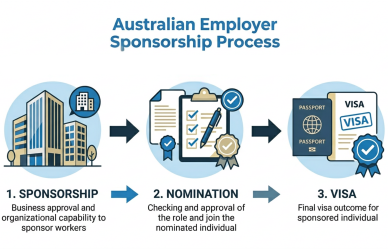
The Three-Stage Process: Sponsorship, Nomination, and Visa
The sponsorship process is broken down into three distinct stages, each with its own requirements and approval steps.
Stage 1 – Standard Business Sponsorship (SBS) Application: The employer applies to the Department of Home Affairs to become an approved sponsor. This requires demonstrating that the business is actively and lawfully operating in Australia and has the capacity to meet all sponsorship obligations. Once approved, SBS status is generally valid for five years.
Stage 2 – Nomination Application: The employer nominates a specific position for a specific skilled worker. This stage requires the employer to prove the genuine need for the role, demonstrate that the salary meets the required thresholds, and in most cases complete Labour Market Testing.
Stage 3 – Visa Application: The skilled worker applies for the visa. This is primarily the worker’s responsibility, but the employer must ensure the worker meets the relevant eligibility criteria, including skills, qualifications and English language proficiency.
If you are preparing for Stage 1 or 2 and want to make sure your documentation is in order before you lodge, our team is happy to take a look. Email us at [email protected] and we can arrange a time to go through it with you.
Key Visa Types: Skills in Demand (SID 482) vs Permanent Residency (ENS 186)
| Visa Subclass | Type | Primary Purpose | Pathway to PR | Employer Obligations |
|---|---|---|---|---|
| Skills in Demand (SID) Subclass 482 | Temporary | To address temporary skill shortages. Allows the worker to remain in Australia for up to four years. | Yes, commonly via the 186 Temporary Residence Transition stream. | Ongoing compliance obligations apply for the full duration of the visa. |
| Employer Nomination Scheme (ENS) Subclass 186 | Permanent | To allow skilled workers to live and work in Australia on a permanent basis. | Permanent residency is granted directly upon visa approval. | Ongoing compliance obligations cease once the visa is granted, but nomination requirements must be fully met. |
The ENS Subclass 186 visa operates across three streams: the Direct Entry stream (for applicants who meet strict skills and English language criteria), the Temporary Residence Transition stream (for workers who have already been sponsored under a temporary visa such as the SID 482), and the Labour Agreement stream.
The Role of the Standard Business Sponsor (SBS)
SBS approval is the gateway into the employer-sponsored visa program. To gain and maintain this status, the business must demonstrate that it is a lawfully operating entity in Australia with a genuine commitment to employing local labour and complying with all relevant Australian laws. SBS approval is not a right. It is a privilege granted by the Department of Home Affairs, and the Department actively monitors sponsors throughout the life of the approval to ensure program integrity is maintained.
Part 2: Essential Pre-Nomination Checklists: LMT, TSMIT, and Genuine Position
Before lodging a nomination application, employers must satisfy several critical requirements that demonstrate both the genuine need for an overseas worker and the fairness of the proposed employment terms.
Labour Market Testing (LMT): Proving the Genuine Need
Labour Market Testing is a mandatory requirement for most sponsored nominations. It requires the employer to demonstrate that they made a genuine attempt to recruit a suitably qualified Australian citizen or permanent resident before turning to an overseas worker.
The Requirement: LMT typically involves advertising the position on at least two national recruitment platforms for a minimum of 28 consecutive days.
The Standard: The process must be genuine. Advertisements must be written in English, include the position title, the name of the sponsoring employer, and clearly state the required skills and experience for the role.
Exemptions: Certain international trade obligations or specific occupations may be exempt from LMT requirements. Employers should always seek professional advice before assuming an exemption applies to their circumstances.
Meeting the Temporary Skilled Migration Income Threshold (TSMIT)
The TSMIT is the minimum annual salary that must be paid to any sponsored worker. It is set by the government and is reviewed periodically.
TSMIT vs Annual Market Salary Rate: The employer must pay the sponsored worker whichever is higher: the TSMIT, or the Annual Market Salary Rate (AMSR) for the nominated occupation. The AMSR reflects what an equivalent Australian worker would be paid to perform the same work in the same location.
Current Threshold: The TSMIT applicable to nomination applications lodged between 1 July 2024 and 30 June 2025 is AUD 73,150, with a further increase to AUD 76,515 expected from 1 July 2025. Given that these figures are subject to indexation, employers should verify the current threshold with a Registered Migration Agent before lodging any nomination.
Defining a Genuine Position and Avoiding Scrutiny
The nominated position must be a genuine role within the business. This means the position must be real, full-time and necessary for the operation of the business. A role that appears to have been created solely to secure a visa for the worker will not satisfy this requirement.
Evidence of Genuine Need: Employers must provide evidence that the position is consistent with the nature and scope of the business and that the role offers full-time employment for at least two years.
Common Red Flags: Nominating a position that is inconsistent with the business’s size, structure or industry, or one where the described duties are vague or overly broad, significantly increases the risk of nomination refusal.
The Skilling Australians Fund (SAF) Levy: What Employers Must Pay
The SAF levy is a mandatory, non-recoverable contribution paid by the employer at the time of nomination. Its purpose is to support the training and upskilling of Australian workers. This cost cannot under any circumstances be passed on to the sponsored employee.
| Business Size | SID (482) Visa Per Year | ENS (186) Visa One-Off Payment |
|---|---|---|
| Small Business (Annual turnover under AUD 10 million) | AUD 1,200 | AUD 3,000 |
| Large Business (Annual turnover AUD 10 million or more) | AUD 1,800 | AUD 5,000 |
The SAF levy is tax deductible, but the full cost must be absorbed by the employer. It is not optional and failure to pay will prevent the nomination from proceeding.
If you are working through pre-nomination requirements and want to confirm your business is on the right track before you spend money on the SAF levy and application fees, it is worth having a quick conversation first. Call us on +61 8 6288 3775 and we can give you a plain-language rundown of where things stand.
Part 3: The 5 Critical Obligations: Your Compliance Checklist for the Life of the Visa
Once a worker is sponsored, the employer takes on a set of ongoing legal obligations that must be maintained for the entire duration of the visa. These are not formalities. Failure to comply with any of them can result in significant sanctions, including financial penalties and loss of sponsorship approval.
Obligation 1: Ensuring Equivalent Terms and Conditions of Employment
The sponsored worker must be employed on terms and conditions that are no less favourable than those provided to an equivalent Australian employee performing the same duties in the same location.
Market Salary Rate: This is where the TSMIT and AMSR interact directly with ongoing compliance. The employer must ensure the worker’s salary is reviewed regularly and remains at or above both the nominated rate and the current AMSR for the occupation.
Fair Work Compliance: All Australian workplace laws apply equally to sponsored workers. This includes entitlements relating to leave, ordinary hours of work, and workplace health and safety. Sponsored workers cannot be treated differently from Australian employees simply because of their visa status.
Obligation 2: Notification of Events (The 28-Day Rule)
One of the most frequently overlooked compliance duties is the obligation to notify the Department of Home Affairs of certain events. This is commonly referred to as the 28-Day Rule because sponsors must inform the Department in writing within 28 calendar days of any notifiable event occurring.
The purpose of this obligation is to ensure the Department has accurate, up-to-date information about both the sponsored worker and the sponsoring entity at all times. Notifiable events are broad in scope. They include changes to the business itself, such as a change in legal name, trading name, structure or ownership, as well as insolvency. They also cover the sponsored employee’s circumstances, including if a sponsored worker ceases employment, is absent from work for a significant period, or if there is a material change in the worker’s duties that falls outside the scope of the original nominated position.
This obligation does not end when a visa is granted. It continues for the entire duration of the sponsorship approval and, in certain circumstances, for up to two years after the sponsorship ends. Missing the 28-day window is one of the most common triggers for compliance audits, even when the underlying event is entirely routine, such as a voluntary resignation. Establishing a documented internal process for HR teams to immediately identify and report notifiable events is not optional. It is an essential part of any compliance framework.
Obligation 3: Maintaining Records and Documentation
Sponsors must maintain comprehensive records to demonstrate compliance with all obligations. These records must be produced upon request during any monitoring or audit activity conducted by the Department of Home Affairs.
Required Records: Record keeping obligations cover salary payments, tasks performed, leave taken, employment contracts, LMT evidence, payslips and any requests for travel cost payments. Organisational charts and position descriptions should also be retained and kept current.
Retention Period: Records must generally be kept for the full duration of the sponsorship and for a minimum of two years after the sponsorship arrangement ceases. Documents that cannot be produced during a monitoring activity are treated as an absence of evidence, regardless of whether the underlying obligation was actually met.
Obligation 4: Paying Costs and Not Recovering Them from the Worker
Employers must pay all costs associated with becoming a sponsor and lodging nomination applications. This includes the SAF levy, government application fees and migration agent fees. These costs cannot be recovered from the sponsored worker or their family members, either directly or indirectly through salary deductions or other arrangements.
Travel Costs: If a sponsored employee requests in writing to return to their home country, the sponsor must meet the reasonable travel costs of the worker and any sponsored family members within 30 days of that request. This obligation applies regardless of the circumstances of the worker’s departure.
Obligation 5: Cooperating with Inspectors and Monitoring
Sponsors must cooperate fully with the Department of Home Affairs and its authorised inspectors during any monitoring or compliance activity. This includes providing access to business premises, making staff available for interview, and producing documents as requested. Obstructing or failing to cooperate with inspectors is itself a compliance breach and can escalate what might otherwise have been a routine monitoring visit into a formal enforcement action.
If your business has received a monitoring request or you are uncertain about how to respond to a Department inquiry, getting advice quickly is important. Reach out at [email protected] and we can help you understand your position and respond appropriately.
Part 4: What Happens When Compliance Fails: Fines, Bans, and Reputational Damage
Non-compliance with sponsorship obligations is treated seriously by the Department of Home Affairs. The consequences can extend well beyond a financial penalty and in some cases affect the entire future of the sponsorship program within the business.
Common Breaches and How to Prevent Them
The most common compliance breaches tend to cluster around financial obligations and notification requirements.
Underpayment: Paying the sponsored worker less than the nominated salary or below the applicable TSMIT or AMSR. Prevention requires a robust payroll audit process and annual salary reviews that are benchmarked against the current AMSR for the occupation.
Cost Recovery: Attempting to recoup sponsorship costs such as the SAF levy or nomination fees from the worker. Prevention requires clear internal policies and employment contracts that explicitly identify which costs are the employer’s sole responsibility.
Failure to Notify: Missing the 28-day deadline for reporting notifiable events such as a worker’s termination or role change. Prevention requires a documented internal HR process that flags notifiable events immediately and assigns a named person to submit the required notification.
Sanctions and Penalties for Non-Compliance
The Department of Home Affairs has a broad range of enforcement options available when sponsors fail to meet their obligations.
Infringement Notices: Fines for minor or administrative breaches.
Civil Penalties: Substantial financial penalties for serious breaches, which can reach into the hundreds of thousands of dollars for corporate entities.
Sponsorship Bar: The business can be barred from sponsoring any new workers for a defined period.
Cancellation of Sponsorship: The SBS approval itself can be cancelled, which means the business must cease sponsoring all current workers and loses the ability to lodge new nominations.
Public Naming: The Department can publish the name of the business and details of the sanctions imposed. This has significant reputational consequences that can affect relationships with clients, recruitment pipelines and future workforce planning.
Audits and Monitoring by the Department of Home Affairs
The Department conducts both proactive and reactive monitoring activities. Audits can be triggered by a complaint from a current or former sponsored worker, information received from partner government agencies such as the Fair Work Ombudsman, or through random selection as part of the Department’s standard program integrity activities.
During an audit, inspectors have the authority to enter business premises, interview staff and request access to all documents relevant to the sponsorship. The breadth of this power means that organisations with incomplete or disorganised records are at a significant disadvantage, even if the underlying obligations were actually met. Preparation before an audit is always preferable to scrambling to locate documents once inspectors arrive.
If you want to understand how audit-ready your business currently is, our team can work through a compliance review with you. Call us on +61 8 6288 3775 for a straightforward conversation about what an assessment would involve.
Conclusion: Building a Robust and Compliant Sponsorship Program
Navigating Australian employer sponsorship compliance requires more than filling out forms and lodging applications. It demands a proactive, structured and ongoing approach to managing your sponsored workforce across every stage of the visa lifecycle. By understanding and prioritising the five critical ongoing obligations, from ensuring equivalent terms and conditions through to meeting the 28-day notification rule, your business can access global talent with confidence while protecting itself from penalties that can have lasting operational and reputational consequences.
Next Steps for HR Teams and Business Owners
Establish Internal Processes: Create clear, documented internal procedures for Labour Market Testing, TSMIT checks and the 28-day notification of events. Assign named owners for each area of compliance within your HR or operations team.
Conduct Regular Internal Audits: Review your compliance position at least twice a year to proactively identify and correct any gaps before they become official breaches or audit triggers.
Seek Professional Advice: Engage a Registered Migration Agent for all new nominations, when a sponsored worker’s circumstances change, or whenever you are uncertain about how a regulatory update affects your obligations. The cost of proactive advice is consistently lower than the cost of responding to a compliance breach.
Legal Disclaimer and Verification Note
Disclaimer: The information provided in this guide is for general informational purposes only and is based on publicly available information regarding Australian migration law and policy as of the date of publication. It is not intended to constitute legal advice, migration advice or professional consultation. Migration law is complex and subject to frequent change. Before making any decisions or taking any action regarding employer sponsorship, compliance obligations or visa applications, you should consult with a Registered Migration Agent (MARN) or a qualified legal professional. Reliance on any information provided in this guide is solely at your own risk.
If you have questions about your current compliance position or want to talk through a specific situation, we are here to help. You can reach our team by phone on +61 8 6288 3775 or by email at [email protected].