
Community Nursing Jobs in Australia: How to Get Into Community Health
You are tired of twelve hour shifts. The rapid admissions, the constant alarms, the lack of continuity with your patients. Community nursing looks like the answer. Better hours. More autonomy. Patients in their own homes. But community health is not hospital nursing on a slower schedule. It is a completely different operating model. You manage your own caseload. You make clinical decisions without immediate senior backup. You navigate transport, documentation, and complex home environments. If you want to make the switch successfully, you need to understand what the role actually requires, how your hospital skills translate, and where employers are actively hiring. This guide maps the exact pathway from ward to community.
In This Article
- The Current Community Nursing Landscape in Australia
- What Community Nursing Actually Looks Like Day-to-Day
- Hospital Skills That Transfer (And What You Need to Learn)
- Where Community Nurses Work in Australia
- Pay, Rostering, and Contract Types
- Community Nursing Versus Hospital Nursing: Side by Side
- Common Mistakes When Transitioning to Community Health
- Step-by-Step: How to Apply and Get Hired
- Your Next Steps
- Frequently Asked Questions
The Current Community Nursing Landscape in Australia
[NATIONAL] Jobs and Skills Australia lists registered nurses on its Core Skills in Demand list, with community health nursing showing consistent growth as aged care and NDIS frameworks shift care delivery out of hospitals. Primary Health Networks (PHNs) now commission large volumes of home-based services, reducing readmission rates and keeping patients out of emergency departments. This structural shift has created steady demand for nurses who can manage chronic conditions, wound care, and post-surgical recovery outside clinical facilities.
Hospital systems are under pressure to discharge patients earlier. Community nurses absorb that transition. They assess wounds, manage complex medication regimens, and coordinate with GPs, allied health, and family carers. The work is highly autonomous. It rewards strong clinical judgement, clear communication, and the ability to work without immediate backup. If you can demonstrate those traits on paper and in interviews, community health roles are accessible.
If you want to understand how your current hospital experience aligns with active community nursing vacancies, the Greener Grass team can map your profile to direct listings in your preferred region. Book a time here.
What Community Nursing Actually Looks Like Day-to-Day
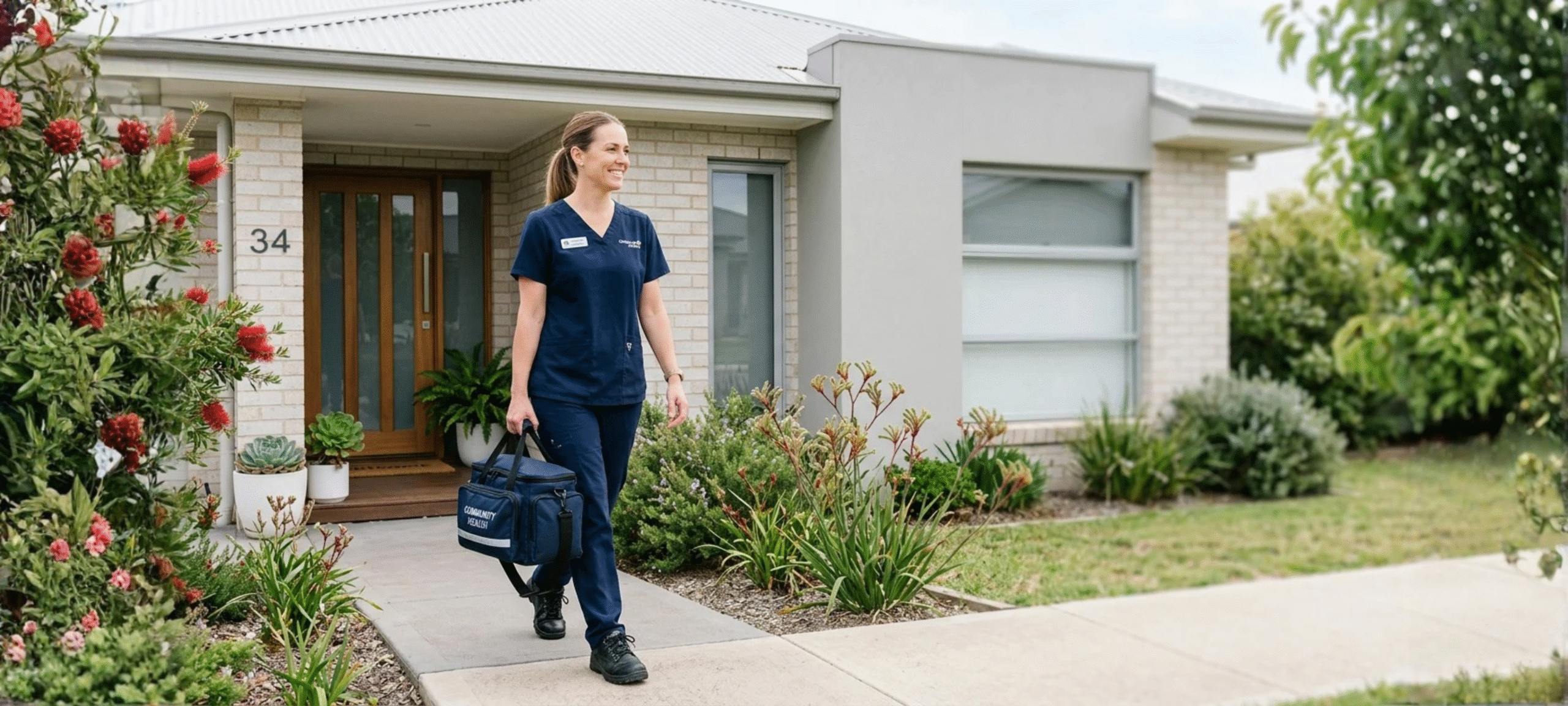
A typical day starts earlier than a hospital shift. You review your route, pack wound care supplies, medications, and assessment tools, then drive to your first client. The pace is steady but demands high organisational capacity. Here is a realistic morning for a community RN in a metropolitan area:
- 7:30 am: Route review and caseload prioritisation. Flag high-risk visits or complex wound changes.
- 8:15 am: First home visit. Assess surgical wound, remove sutures, update electronic documentation.
- 9:30 am: Chronic disease management visit. Review insulin administration, adjust care plan with GP via secure portal.
- 10:45 am: Palliative care visit. Administer symptom relief medication, support family carers, coordinate with allied health.
- 12:00 pm: Documentation and handover notes. Submit compliance records and incident reports through mobile platform.
You manage travel between sites. You handle equipment sterilisation in non-clinical environments. You make independent decisions about escalation pathways. The work removes hospital bureaucracy but replaces it with route planning, vehicle maintenance costs, and strict documentation compliance. If you value patient continuity and self-directed practice, community nursing delivers it. If you prefer structured team environments and immediate clinical backup, the transition requires adjustment.
Hospital Skills That Transfer (And What You Need to Learn)
Your acute care background gives you a strong clinical foundation. Community employers value wound management, medication safety, and rapid assessment skills. You must translate them into community-specific language.
Skills that transfer directly: Complex wound care, IV therapy, catheter management, polypharmacy reviews, patient education, and clinical documentation. Employers expect you to manage these without supervision.
Skills you need to develop: Independent care planning, remote GP coordination, home environment risk assessment, and mobile documentation systems. In hospital, you call a registrar or charge nurse. In community, you assess, document, and escalate through structured protocols. Confidence in solo decision making is the primary hiring filter.
When updating your resume, reframe hospital experience around independence and continuity. “Coordinated multidisciplinary handovers” becomes “Liaised with GPs, physiotherapists, and family carers to maintain continuity of care in non-clinical settings”. “Managed high acuity ward patients” becomes “Delivered autonomous clinical assessments and wound management for diverse patient cohorts”. The clinical skill is identical. The framing signals readiness for community work.
Where Community Nurses Work in Australia
Community nursing roles span multiple providers. Knowing where to look saves time and increases your chances of finding the right fit.
Primary Health Networks and government clinics: State and federal PHNs commission chronic disease programs, vaccination drives, and remote health initiatives. Roles often include structured orientation and clear progression pathways. [STATE: NSW] and [STATE: VIC] PHNs frequently recruit for regional health initiatives with relocation support.
Aged care and disability providers: Home care packages and NDIS plans fund in-home nursing support. Roles focus on wound care, medication administration, and carer education. Demand is highest in metropolitan corridors and growing rapidly in regional centres.
Private home health companies: Independent providers contract with hospitals for post-surgical follow up, oncology support, and palliative care. These roles often offer flexible scheduling and higher hourly rates. You manage your own client list within a defined service area.
Rural and remote health services: [STATE: QLD] and [STATE: WA] communities rely heavily on community nurses for primary care delivery. Roles include fly-in fly-out arrangements, higher base pay, and broader scope of practice due to limited local medical access.
Pro tip: Search for “community nurse”, “district nursing”, and “home health RN” across your target region. Many roles advertise under different titles but require identical clinical competencies.
Pay, Rostering, and Contract Types
Community nursing compensation follows the Nurses and Midwives Award 2020, but roster structures differ significantly from hospital shifts. Base rates align with your years of experience and classification level. Penalties apply for evening and weekend visits, though travel time is usually compensated at base rate rather than penalty loading.
Permanent roles offer guaranteed hours, paid leave, and vehicle allowances or kilometre reimbursements. You typically work standard business hours with occasional on-call rotations for urgent visits. Casual community nursing provides higher hourly loading but requires you to cover your own vehicle maintenance, fuel, and insurance. Confirm the travel compensation structure before accepting any offer. Unreimbursed travel costs quickly erode the casual loading advantage.
Documentation compliance is strict. Mobile health platforms require real-time clinical notes. Facilities audit completion rates and tie performance reviews to documentation accuracy. Missing entries or delayed submissions trigger compliance flags that affect your probation assessment.
Community Nursing Versus Hospital Nursing: Side by Side
| Factor | Community Nursing | Hospital Nursing |
|---|---|---|
| Clinical Environment | Patient homes, clinics, aged care facilities, mobile practice | Ward-based, controlled clinical environment |
| Decision Autonomy | High. Independent assessment and escalation required | Moderate. Charge nurse and medical team immediate backup |
| Roster Structure | Standard business hours, route-based scheduling, occasional on-call | Shift work (days, nights, weekends, rotating rosters) |
| Travel Requirements | Essential. Vehicle required. Travel time compensated | None. Work confined to facility grounds |
| Continuity of Care | High. Same patients over weeks or months | Low. Rapid patient turnover and shift handovers |
Use this comparison to evaluate which environment aligns with your lifestyle and clinical preferences. Neither model is superior. They serve different patient populations and reward different working styles.
Common Mistakes When Transitioning to Community Health
Even experienced ward nurses encounter friction when moving to community roles. Avoid these pitfalls.
Underestimating documentation demands. Community health requires real-time electronic charting. You document in your vehicle between visits. Employers audit completion rates weekly. Missing entries or delayed submissions trigger compliance reviews. Treat documentation as a clinical skill, not an administrative afterthought.
Ignoring travel compensation details. Casual rates look higher until you factor in fuel, vehicle servicing, and insurance. Permanent roles often provide vehicle allowances or fleet cars. Request the exact travel reimbursement structure before signing. Uncompensated kilometres reduce your effective hourly rate significantly.
Applying without solo practice evidence. Community employers prioritise candidates who demonstrate independent clinical judgement. Your resume must highlight autonomous wound assessments, medication management without immediate supervision, and direct GP coordination. Ward experience framed purely around team collaboration signals hesitation for community roles.
Assuming orientation mirrors hospital onboarding. Community orientation focuses on route planning, mobile software training, and home safety protocols rather than ward-specific equipment. Expect a shorter clinical induction period. You will be expected to integrate into your caseload quickly.
Step-by-Step: How to Apply and Get Hired
Securing a community nursing role requires targeted preparation. Follow this sequence to align your hospital experience with community health requirements.
- Update your resume: Translate ward experience into community-relevant language. Highlight autonomous clinical assessments, wound management, and multidisciplinary coordination.
- Verify travel requirements: Confirm whether the role provides a vehicle, kilometre reimbursement, or requires personal transport. Factor travel costs into your compensation evaluation.
- Prepare compliance documents: Have your AHPRA registration, national police check, immunisation record, and valid driver’s licence ready for upload.
- Apply directly to PHNs, home health providers, and aged care networks: Use platforms like Greener Grass to connect with facilities hiring community nurses without agency intermediaries.
- Prepare for interview: Practice scenarios around home environment risk assessment, solo clinical escalation, and mobile documentation workflows.
- Ask the right questions: “How is travel time compensated?”, “What mobile documentation system do you use?”, “What is the average daily visit load?”, “How is after hours clinical support structured?”
Your Next Steps
Community nursing delivers autonomy, flexible scheduling, and deep patient continuity. It requires independent clinical judgement, strict documentation discipline, and proactive travel management. Follow this sequence to secure a role that aligns with your career goals.
- Map your current clinical competencies against community health requirements using the transferable skills framework above.
- Calculate your effective hourly rate after factoring in travel compensation, vehicle costs, and roster structure.
- Update your resume to emphasise autonomous clinical decision making and continuity of care.
- Apply to community health providers, PHNs, and home health networks in your target region.
- Prepare documentation compliance workflows before your start date to avoid probation delays.
Moving from hospital to community nursing changes how you manage caseloads, documentation, and patient relationships. You need transparent role details and direct employer access to make the switch confidently. Chat with us on WhatsApp: https://wa.me/61862883775. Book a consultation: https://greenergrass.com.au/book-appointment/.
Frequently Asked Questions
Can I transition to community nursing without prior home health experience?
Yes. Many providers hire hospital-trained RNs and ENs and provide orientation focused on route planning, mobile documentation, and home environment assessment. Your clinical foundation matters more than prior community experience. Demonstrate autonomous clinical judgement and clear documentation habits during the interview process.
Do community nurses work weekends or after hours?
Most community roles operate during standard business hours. Some providers require occasional weekend visits or on-call rotations for urgent wound care or palliative support. After hours work typically attracts penalty rates. Confirm the exact roster structure and on-call frequency before accepting an offer.
Is a vehicle mandatory for community nursing roles?
Yes. You will travel between patient homes or clinics daily. Most providers require a reliable vehicle, valid driver’s licence, and comprehensive insurance. Some employers offer fleet vehicles or kilometre reimbursements. Others require you to use your personal car with a per-kilometre allowance. Clarify the arrangement during the interview stage.
How does community nursing pay compare to hospital nursing?
Base rates align under the Nurses and Midwives Award. Community roles typically offer fewer weekend penalty opportunities but compensate through vehicle allowances, higher base classifications for autonomous practice, and structured overtime for complex visits. Calculate total compensation including travel reimbursement, not just hourly rate, to compare accurately.
What documentation systems do community nurses use?
Most providers use mobile health platforms that sync directly with centralised electronic medical records. You complete clinical notes in real time on a tablet or smartphone during or immediately after visits. Training covers platform navigation, compliance requirements, and audit protocols. Expect a short orientation period before you manage your own caseload independently.
Disclaimer
The information contained in this article is general in nature and does not constitute legal, financial, or professional advice. It has been prepared without taking into account your individual objectives, financial situation, or specific needs. Before acting on any information in this article, you should consider its appropriateness for your circumstances and seek independent professional advice from a qualified adviser. Regulatory requirements, award rates, and employment regulations are subject to change. This article reflects information available as of May 2025. Broker360 Pty Ltd is not responsible for any actions taken based solely on the content of this article.
Your clinical skills transfer well to community health when framed around autonomy, continuity, and independent decision making. Understanding the exact requirements and compensation structure puts you in control of your career transition. Explore direct community nursing listings on Greener Grass.